

M&A FOMO! How Social Media Shape M&A Decisions
Does social media shape which targets companies pursue? Christoph Brielmaier, Moritz Reis, Martin Friesl and Roland Pfister on the M&A fear of missing out.
1. Acquisitions: Strategic decision or herd behaviour instead?
Acquisitions are a key driver of corporate strategy. The strategic selection and valuation of suitable targets, alongside their monitoring, are central to positioning companies for the future. The strategic selection of targets ideally follows a sustainable and sound logic of value creation. Such a logic explicitly articulates the specific contribution a particular acquisition can make, such as complementary technologies and markets or cost synergies and how these contributions can be realised, for example through target integration. So far, so simple, or so it seems! Although the approach outlined above is unlikely to face much criticism, it nevertheless rests on a problematic assumption: that acquisition decisions are the result of rational, strategic considerations.
Indeed, research in the field of M&A shows that acquisitions are frequently not rooted in strategic decisions at all. Instead, they are often driven by much less rational forces. Acquisitions are commonly the result of herd behaviour in short-lived ’industry fads’, which manifest in cyclical M&A waves.² Indeed, sociologists have given this phenomenon an apt, if unwieldy, name: mimetic isomorphism.³ It describes how companies operating under uncertainty mirror other market players they view as exceptionally legitimate, capable, and successful. The visible behaviour of these players is copied in order to be viewed as legitimate and successful as well. The risks are obvious. While early movers often still enjoy advantages, herd behaviour frequently leads to inflated purchase prices that can diminish or even eradicate the future value contribution of an acquisition.⁴ In the worst-case scenario, there is no strategic rationale whatsoever for an acquisition, leaving both the target and the acquiring company worse off.
This raises the question of what drives ubiquitous herd behaviour in companies. That is: What market signals trigger ’M&A FOMO’ (fear of missing out)? Existing research demonstrates that board interlocks serve as an information channel fuelling M&A FOMO.⁵ This makes intuitive sense: Information regarding planned transactions comes directly from the source, possessing high density and quality. This enables board members to thoroughly evaluate both the strategic relevance and the intended value contribution of planned acquisitions.
However, we must assume that gathering information via board interlocks is a special case. Not all M&A signals are of this quality. Quite the contrary: decision-makers are exposed to a vast amount of information that makes identifying suitable targets a major challenge. One source of this information flood is social media, particularly LinkedIn. This professional social network has long established itself as a central channel for communication and self-marketing. The information landscape surrounding acquisitions on LinkedIn is twofold: on the one hand, social media acts as a source of market sentiment and rumours; on the other, there are confidential, organisational channels and verified facts. Against this backdrop, the question arises whether information from LinkedIn plays any role in acquisition decisions at all. We investigated this question in a recent study published in the journal Long Range Planning.⁶
2. Acquisitions in the Attention Economy
It is useful to frame the impact of social media on acquisition decisions as a problem of attention allocation. Attention is the prerequisite for data-driven corporate decisions, yet management’s attentional capacity is extremely scarce. Acquisitions are just one way to implement strategic options, meaning investments in M&A compete against various other initiatives. Extensive research in recent years has demonstrated that attention allocated to specific strategic options depends not only on the interests of key actors but is heavily influenced by the organisational context. This includes key executives, organisational rules and processes but also the availability of specific resources.⁷ This context makes the selection of specific problem definitions and courses of action more, or less, likely.
An increasingly important contextual variable is social media. Through these platforms, we connect with individuals both inside and outside the organisation; they serve as news portals, marketing channels, and above all, they are omnipresent. Social media platforms like LinkedIn have become an integral part of everyday business life, especially as viewed from mobile devices. We consume content on LinkedIn while waiting for a train, in between meetings, or even casually during a meeting. Everybody can likely think of many other daily scenarios where social media comes into play. Attention research suggests that this omnipresence turns social media into a ’regulator’ of attention, thereby shaping strategic decisions. Based on this perspective, we examined the extent to which content on social media platforms like LinkedIn can direct managerial attention towards acquisitions.⁸
3. So what? How Does LinkedIn Shape Attention?
3.1 The Experiment
The experiment was conducted with 138 executives. The goal of the experiment was to investigate whether and how consuming LinkedIn posts influences these executives’ strategic preferences.
To simulate this situation, the experiment mirrored the use of LinkedIn within the context of a strategic decision in which participants assumed the role of CEO of an automotive supplier. All participants were initially provided with information about the company and its current situation, alongside a notice that the next management meeting would begin in a few minutes. To pass the time, participants were asked to scroll through a fictional LinkedIn feed. The key element of the experiment lay in the design of this feed: participants were exposed to different versions of this feed, and we systematically varied the content on display. Half of the feeds were dominated by posts about corporate acquisitions, whereas the other half primarily featured organic investments, such as investments in new technologies, production capacity, or employee development. This created a distinct thematic focus in the LinkedIn feeds for each participant group. Furthermore, typical characteristics of the LinkedIn posts were also varied, specifically, the author’s hierarchical position (employee versus top manager) and the posts’ social resonance (few vs. many likes and comments). After scrolling through the feed, participants were surveyed regarding their satisfaction with the company’s current status, and they were asked to allocate a budget of $100 million across various strategic options (acquisitions versus organic investments).
3.2 The results
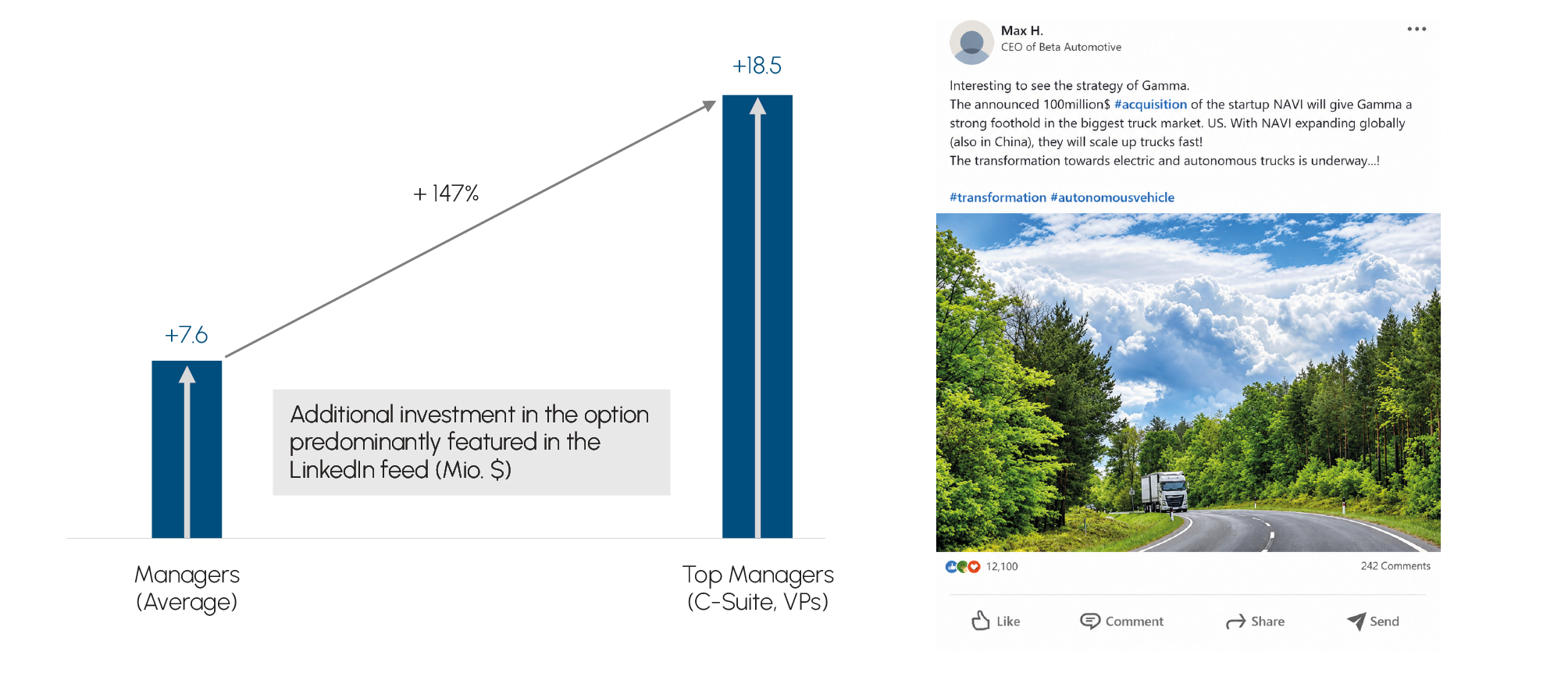
The experimental results demonstrate a striking effect. Figure 1 shows that even brief exposure to LinkedIn posts had a lasting impact on participants’ strategic preferences, resulting in significantly higher budget allocations towards the option predominantly featured in their LinkedIn feed.
Fig. 1 Effect of LinkedIn consumption on M&A investment decisions of normal managers as well as participants in top management roles
 Source: based on Brielmaier et al. (2025)
From the available budget, executives invested an average of around $7.6 million more in whichever strategic option was featured prominently in their LinkedIn feed. In other words, when the feed was dominated by acquisition content, a larger share of the allocated budget went towards acquisitions; conversely, when organic investments dominated, they received greater priority. This effect proved to be robust, persisting even when statistical analysis controlled for individual factors such as age, strategy experience, or intensity of LinkedIn use.
The effect was particularly pronounced among top managers: within this group, budget allocation shifted by an average of $18.5 million towards the strategy dominant in their feed.
However, another finding came as a surprise: neither the author’s hierarchical position nor the number of likes and comments had a direct impact on participants’ strategic preferences. In our experiment, posts by CEOs were no more influential than those by lower-level employees, and highly popular posts with numerous likes and comments fared no better than less popular ones. However, an interesting exception emerged from an unusual combination: posts by lower-ranking individuals that gathered high numbers of likes and comments had a particularly strong influence on strategic preferences for acquisitions or organic growth options. Apparently, it is precisely this counterintuitive combination that catches special attention.
Furthermore, we uncovered another noteworthy effect: Even brief exposure to LinkedIn posts prompted participants to evaluate their own company’s situation more negatively. Observing the activities and achievements of other firms draws attention to potential deficits within one’s own organisation and triggers social comparisons. We therefore examined whether this reduced satisfaction influenced participants’ preferences for specific strategic options. However, this could not be confirmed. Nevertheless, such dissatisfaction might still motivate executives to consider new strategic initiatives, such as acquisitions, to close perceived gaps relative to competitors.
4. Why is that so and what are key implications of our findings?
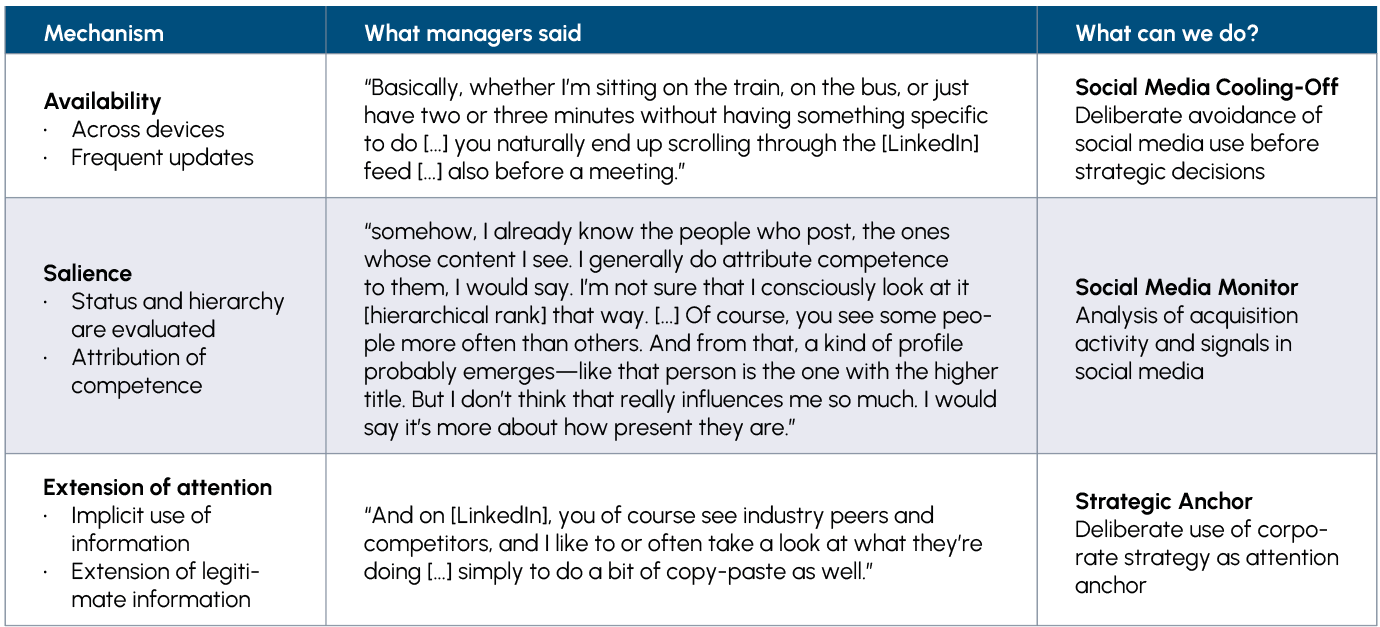
Why do M&A LinkedIn posts have this effect, and what conclusions can and should we draw from this (see overview in Figure 2)?
Fig. 2 Background and implications of findings
 Source: based on Brielmaier et al. (2025)
What is driving these effects? To further unpack the experimental results, we conducted 18 interviews with executives. These conversations revealed that three aspects are of central importance: the high availability of LinkedIn, the salience of the posts, and the expansion of our attentional boundaries. Unlike other media, such as traditional newspapers or even online news outlets, information on social networks like LinkedIn is even more readily available and updated at a faster rate. This constant availability makes it possible to consume relevant information right before entering a meeting. Another key factor is the personal relevance of LinkedIn posts. These posts carry weight for us because they are shared by personal contacts whose status, hierarchy, and competence are known to us and we implicitly evaluate these aspects alongside the message itself. Finally, LinkedIn expands our attentional boundaries. The combination of high availability and salience causes this social media information to compete directly with other, more formal (and likely more reliable) information in strategic decision-making scenarios.
What can we do? Both the experimental findings and the executive interviews point in the same direction, making the potential adverse effects on M&A transactions clear. This brings us to the crucial question: how should companies address this issue? We neither can nor likely want to forgo the undeniably positive aspects of LinkedIn and other social networks. One solution is to adopt (and potentially enforce) a more reflective approach to social media during decision-making processes. This would require clear rules. What might such a policy look like? To restrict the immediate availability of social media during key decision-making windows, companies could establish a ’cooling-off’ period. Executive teams could commit to a self-imposed ban on consuming social media content during the three hours leading up to major strategic meetings. At the same time, this commitment could include systematically monitoring network contacts relevant to potential acquisitions. Who in my network is currently posting about transactions? Making this information transparent, along with structured collection and analysis, could allow firms to leverage the effects of social media strategically rather than reacting to them passively. Finally, how do we address the expansion of our attentional boundaries? Ultimately, the company’s overarching strategy must serve as the primary anchor for executive attention. Strategy remains the ultimate reality check for determining whether acquisitions genuinely contribute to long-term goals or whether the organisation is simply suffering from M&A FOMO.
Sources
This article originally appeared in the German edition of M&A REVIEW (issue 5/2026)
McNamara, G. M., Haleblian, J., & Dykes, B. J. (2008). The performance implications of participating in an acquisition wave: Early mover advantages, bandwagon effects, and the moderating influence of industry characteristics and acquirer tactics. Academy of Management Journal, 51(1), 113-130.
DiMaggio, P. J., & Powell, W. W. (1983). The iron cage revisited: Institutional isomorphism and collective rationality in organizational fields. American Sociological Review, 48 (2), 147-160.
Carow, K., Heron, R., & Saxton, T. (2004). Do early birds get the returns? An empirical investigation of early‐mover advantages in acquisitions. Strategic Management Journal, 25 (6), 563-585.
Haunschild, P. R. (1993). Interorganizational imitation: The impact of interlocks on corporate acquisition activity. Administrative Science Quarterly, 38, 564-592.
Brielmaier, C., Reis, M., Friesl, M., & Pfister, R. (2025). Who sits at the table? LinkedIn exposure shapes managers’ situated attention and strategic preferences. Long Range Planning, 102586.
Bauer, F., & Friesl, M. (2024). Synergy evaluation in mergers and acquisitions: an attention‐based view. Journal of Management Studies, 61 (1), 37-68.
Ocasio, W. (1997). Towards an attention‐based view of the firm. Strategic Management Journal, 18(S1), 187-206.


