

Reinventing M&A: How AI Reshapes the M&A Lifecycle Today and Tomorrow
Michael Klawon, Alexander Herzfeldt, Sebastian Floerecke and Christoph Ertl map how AI reshapes the M&A lifecycle – today and tomorrow.
1. AI in M&A: Context and Motivation
Although the mergers and acquisitions (M&A) process is structurally straightforward, successful transactions depend on complex assessments, strategic foresight and informed decision-making.¹ This explains why investment bankers, consultants, and advisers have commanded substantial fees for decades in helping organisations structure, execute, and realise value from M&A transactions.²
Across the M&A lifecycle, from strategy and transaction to integration, numerous activities are amenable to automation.³ Yet, despite ongoing digitalisation efforts, M&A remains largely human-driven: automation tends to occur within support functions, while critical decisions continue to be prepared and made by humans.⁴ Artificial intelligence (AI) is fundamentally altering this paradigm. Unlike traditional automation technologies, AI can process vast amounts of structured and unstructured data, identify patterns and sentiment, integrate external market intelligence, and generate insights at a scale and speed beyond human capabilities. As a result, AI has the potential not only to improve operational efficiency but also to enhance decision quality throughout the M&A process.⁵
Although numerous publications address the role of AI in M&A, the body of knowledge remains fragmented, making it difficult for practitioners to derive consolidated insights for strategic and operational decision-making.⁶ This article addresses that gap through a structured literature review. It synthesises academic and practitioner perspectives on AI applications across all phases of the M&A process, develops an integrated framework of AI value-creation mechanisms, and identifies those areas in which human judgement remains indispensable despite increasing technological capabilities.
2. The M&A Lifecycle and AI
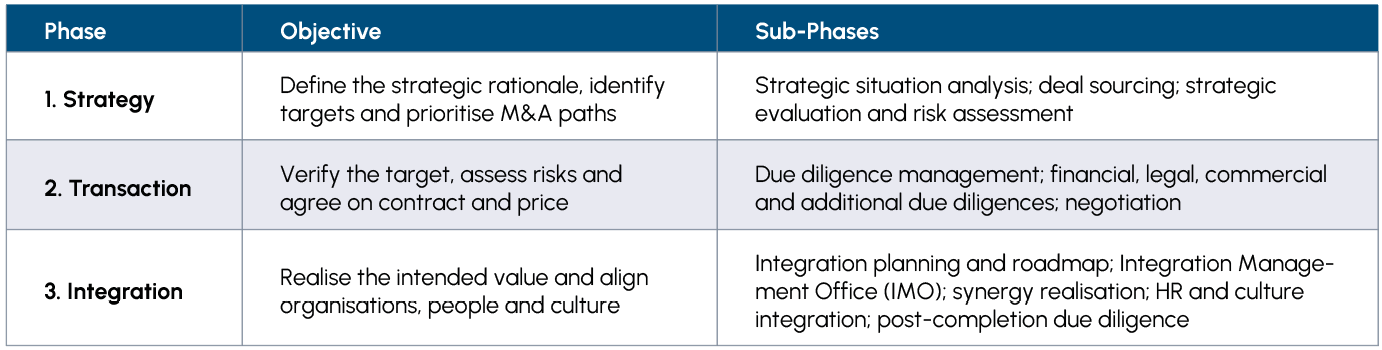
Most practitioners describe the M&A process as a sequence of stages, beginning with target assessment and progressing through financial, legal and operational due diligence, negotiation, closing, and post-merger integration.⁷ Building on that, this article adopts a generalised three-phase model consisting of Strategy, Transaction and Integration (Figure 1), synthesising the literature and practical field experience with a buy-side focus. The strategy phase defines the rationale for inorganic growth and identifies the most promising acquisition targets. The transaction phase verifies the chosen target through due diligence and converts the findings into deal terms, contractual arrangements, and valuation. The integration phase focuses on realising the intended value of the acquisition by aligning organisations, processes, and people after closing. This lifecycle provides the analytical framework for the remainder of the article. Each phase and sub-phase is examined to determine where AI is already creating measurable value, where its applications remain limited, and where human judgement continues to be indispensable.
Fig. 1 Generalised M&A Lifecycle
 Source: own illustration
Among the many definitions of AI, the interpretation proposed by Grewal aligns particularly well with the requirements of the M&A lifecycle: AI is defined as a mechanical system that acquires information and knowledge, interprets and synthesises it, and ultimately transforms it into actionable intelligence.⁸ These activities closely mirror the core tasks performed by internal deal teams and external advisers throughout M&A transactions.⁹ Consequently, M&A represents a particularly suitable domain for AI adoption, as many activities are information-intensive, analytical in nature, and dependent on the efficient processing of large volumes of data.
3. Research Design
Given the nascent state of academic research on AI in M&A, this study adopts a multi-source review approach that integrates both scholarly and practitioner evidence. While academic publications provide conceptual and empirical insights, many recent developments in AI-enabled M&A practices are documented primarily in industry reports, consulting studies, legal analyses, and software vendor publications. Consequently, a comprehensive understanding of the topic requires the inclusion of both academic and practitioner-oriented sources.¹⁰ Between 2024 and spring 2026, Scopus, Web of Science, IEEE Xplore, and the AIS eLibrary were searched with keyword combinations of AI and M&A terms. The same combinations were employed in targeted web searches to identify consulting reports, white papers, case studies and thought-leadership publications from banks, advisers and law firms, and other industry participants. In addition, the websites of leading M&A software providers were systematically reviewed to capture emerging AI-enabled tools and applications. Sources were included if they explicitly addressed the use of AI in at least one phase of the M&A lifecycle. This process resulted in a core corpus of 29 academic studies, supplemented by a broad set of practitioner and vendor sources. All identified materials were systematically coded according to the respective M&A lifecycle phase, the underlying AI technology or technique, and the reported organisational outcomes and value mechanisms.
4. Results: How AI Reshapes M&A along the Lifecycle
4.1 Strategy Phase
AI is already transforming the strategy phase by enhancing strategic analysis and streamlining deal sourcing. In the strategic situation analysis, tools with text mining and machine learning capabilities efficiently process large volumes of macro- and microeconomic data and enrich analytical frameworks such as PESTEL and SWOT. As a result, decision-makers can shift their focus from data collection to interpretation and strategic judgement, improving the foundation for inorganic growth strategies.¹¹ In deal sourcing, AI can identify potential acquisition targets by analysing public databases as well as unstructured information such as company websites. In addition, AI can uncover opportunities from data sources not traditionally associated with M&A, expanding the target universe and increasing the likelihood of identifying attractive acquisition candidates.¹²
Looking ahead, the role of AI is expected to extend beyond data aggregation and screening towards predictive and recommendation-driven capabilities. Emerging platforms not only automate the generation of target lists but also assess strategic fit, monitor market developments, and continuously evaluate acquisition opportunities against predefined investment criteria.¹³ Some scholars envision intelligent matching platforms that connect buyers and sellers based on strategic preferences, transaction objectives, and market conditions, fundamentally reshaping the deal origination process.¹⁴ Further capabilities on the horizon include automated target profiling and the forecasting of post-transaction KPIs through executive-oriented decision-support systems.¹⁵
Despite these advances, the strategy phase remains inherently dependent on human judgement. M&A success is influenced not only by quantifiable factors but also by intangible dimensions such as trust, leadership, organisational culture, and stakeholder relationships. These factors are difficult to capture algorithmically and are often further marginalised by transaction-related time pressures.¹⁶ By reducing the burden of data collection and analysis, however, AI enables executives to spend more time on precisely these human and strategic considerations.
Consequently, AI should be viewed as an augmentation rather than a replacement of managerial decision-making. While it can efficiently generate target shortlists, identify patterns, and provide analytical support, final strategic decisions require contextual understanding, experience, and judgement. Some experts further question whether AI can reliably assess a firm’s strategic situation at the high level of abstraction required for corporate strategy, given its dependence on historical training data and quantifiable inputs.¹⁷
4.2 Transaction Phase
The transaction phase is currently the area of M&A where AI delivers the most tangible and immediate benefits. Many transaction activities are data-intensive, document-heavy, and highly standardised, making them particularly suitable for AI-supported automation. Tasks such as contract review, valuation analysis, code scanning and large-scale data processing have traditionally required substantial manual effort and remain susceptible to human error. Generative AI significantly accelerates these activities, allowing transaction professionals to focus on higher-value analytical and advisory work.¹⁸ This development has been enabled by the transition from physical to virtual data rooms. Modern platforms such as Realtime Due Diligence illustrate this evolution by combining centralised data management, standardised review processes, and increasingly AI-enabled analytical capabilities.¹⁹
Financial due diligence particularly benefits from AI’s ability to process large datasets and extract insights from unstructured information stored in virtual data rooms.²⁰ Within valuation, AI detects anomalies, flags underperforming assets and strengthens time-series analysis.²¹
Legal due diligence represents another high-impact application area. Given its document-intensive and largely standardised nature, legal review is especially well suited to large language models. Traditionally, initial document reviews are often conducted by junior lawyers under considerable time pressure, increasing the risk of omissions and inconsistencies.²² AI-powered legal tech solutions address these challenges by accelerating document discovery, extracting legally relevant information, identifying disclosure risks, and improving review consistency.²³ As these capabilities mature, AI is expected to assume an increasing share of routine legal work while enabling legal professionals to concentrate on strategic and interpretive tasks.
In commercial due diligence, AI-based research engines aggregate information from multiple sources to create company profiles, identify market signals, and flag regulatory or reputational risks.²⁴ In software due diligence, specialised tools analyse source code to assess software quality, licensing compliance, technical debt, and cybersecurity vulnerabilities.²⁵ AI also contributes indirectly to negotiations by accelerating analysis and improving valuation accuracy, thereby enabling deal teams to respond more effectively to changing negotiation dynamics. More directly, AI can benchmark contract clauses against market standards and identify potential gaps or deviations.²⁶
Looking forward, AI is expected to move beyond task automation towards continuous and increasingly intelligent due diligence. Future systems may enable real-time risk assessments, dynamically update findings as new information becomes available, and refine recommendations through learning from historical transaction data.²⁷ Forecasts suggest that AI could eventually take over up to 96% of due diligence tasks (62% partially and 34% fully).²⁸ Growing confidence in the cost and efficiency benefits of AI is already accelerating adoption despite earlier concerns regarding data privacy and confidentiality.²⁹
Nevertheless, the transaction phase remains far from fully automatable. Many activities require contextual reasoning, negotiation skills, and the ability to balance competing stakeholder interests. Negotiations, in particular, depend on judgement, persuasion, relationship management, and strategic trade-offs that AI cannot replicate.³⁰ Likewise, legal and financial professionals continue to play a critical role in interpreting findings, assessing implications, and translating analytical outputs into transaction decisions.
Practical limitations further constrain adoption. Smaller target companies often lack structured and digitally accessible data, confidentiality requirements may restrict the use of external AI systems, and regulatory frameworks such as the EU AI Act impose additional compliance obligations.³¹ Moreover, while AI can effectively identify patterns and anomalies, it frequently lacks the causal understanding required to explain findings or assess their strategic significance. As a result, AI currently functions as a powerful decision-support tool rather than an autonomous decision-maker, augmenting rather than replacing human expertise throughout the transaction process.³²
4.3 Integration Phase
AI increasingly supports post-merger integration by enhancing planning, coordination, and performance monitoring. During integration planning, AI contributes to the development of integration roadmaps by identifying required tasks, detecting process redundancies, pinpointing potential cultural friction points, and uncovering optimisation potential. Generative AI further accelerates reporting by drafting status updates, summarising project developments, and visualising key performance indicators for management teams.³³ The Integration Management Office (IMO) also benefits from AI-enabled tools that streamline communication, automate reporting, and monitor milestones across workstreams. By combining real-time project data with insights from historical transactions, these systems help integration leaders identify emerging risks, anticipate bottlenecks, and adapt integration measures more proactively.³⁴
AI also contributes to synergy realisation, one of the primary determinants of transaction success. By analysing operational, organisational, and financial data, AI can identify overlapping functions, recommend best practices, and highlight efficiency improvements that may have been overlooked during due diligence. As these systems increasingly learn from prior transactions, their ability to predict post-merger outcomes and recommend value-creation initiatives is expected to improve further. In HR and culture integration, AI supports workforce planning by forecasting talent requirements, identifying skill gaps, and informing retention, recruitment, and upskilling strategies. AI-powered chatbots and digital assistants can additionally facilitate communication across merging organisations by providing employees with a centralised point of access for information and support throughout the integration process.³⁵
Post-completion due diligence represents another area of application. Once full access to the target’s data becomes available, AI can reassess financial and operational assumptions, validate deal hypotheses, and identify deviations from pre-acquisition expectations. These insights help management refine integration priorities and improve value-capture efforts.
Despite these benefits, the literature suggests that AI’s contribution in the integration phase is inherently more limited than in the transaction phase.³⁶ While integration generates substantial amounts of data, its success ultimately depends on leadership, communication, trust, and cultural alignment. These factors remain difficult to quantify and cannot be effectively managed through analytical tools alone. Consequently, AI serves primarily as an enabler of coordination, transparency, and decision support, while responsibility for guiding organisational change and building a shared post-merger culture continues to rest with managers and employees.
4.4 Cross-Phase Framework: AI Value Mechanisms
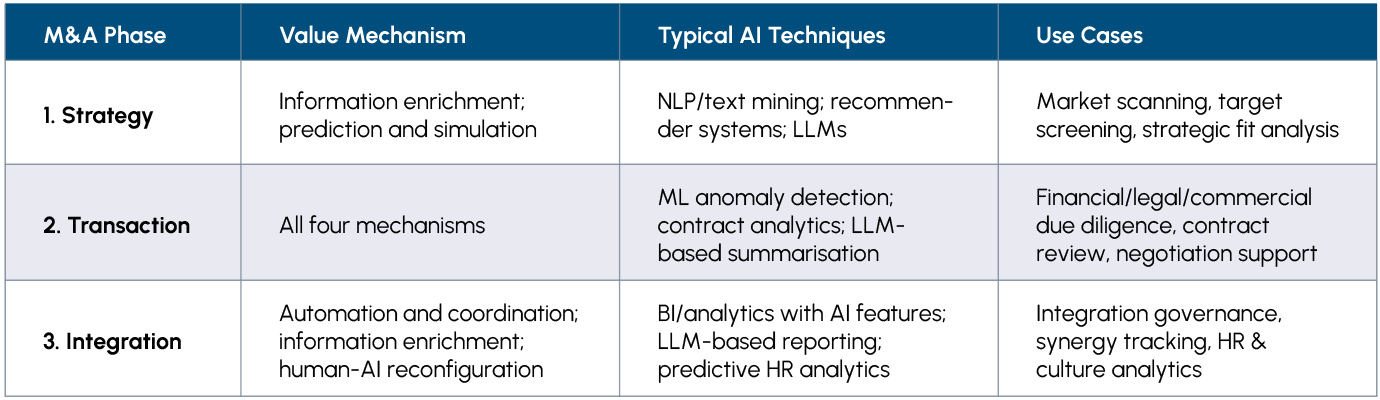
Across the M&A lifecycle, AI creates value through four recurring mechanisms that transcend individual phases and use cases (Figure 2). First, information enrichment expands and improves the decision base by processing large volumes of structured and unstructured data. Second, automation and coordination reduce manual effort, standardise workflows, and improve collaboration across multiple stakeholders. Third, prediction and simulation support decision-making by forecasting outcomes, identifying risks, and assessing alternative scenarios. Finally, human-AI reconfiguration describes the gradual shift from AI as a purely supportive tool towards a semi-autonomous contributor that increasingly performs analytical tasks independently, while humans retain responsibility for strategic decisions, legal accountability, and relationship management.
Fig. 2 AI Value Mechanisms across the M&A Lifecycle
 Source: own illustration
The relative importance of these mechanisms varies across the M&A lifecycle. In the strategy phase, AI primarily creates value through information enrichment and predictive capabilities that support market analysis, target identification, and strategic fit assessment. In the transaction phase, all four mechanisms are prominent, reflecting the data-intensive nature of due diligence and deal execution. During integration, AI focuses on coordination, monitoring, and organisational support, while human judgement remains critical for cultural alignment, leadership, and stakeholder management.
Overall, AI creates value in M&A by augmenting rather than replacing human decision-makers. It strengthens information processing, analytical depth, and workflow efficiency, while strategic judgement, negotiation, leadership, and cultural integration remain firmly human domains. This balance explains both the rapid adoption of AI and the enduring importance of human expertise throughout the deal lifecycle.
5. Discussion
AI’s impact on M&A is most visible in data-intensive activities, particularly within due diligence and integration governance, where large volumes of information must be processed, analysed, and coordinated efficiently. However, four structural limitations currently constrain its effectiveness across the lifecycle. First, most AI solutions remain siloed. As a result, outputs often need to be transferred manually between virtual data rooms, communication platforms, and workflow systems, limiting the realisation of fully integrated, AI-enabled deal processes. Second, AI lacks legal and organisational agency: while it can generate analyses, recommendations, and draft documents, it cannot assume accountability for their consequences. Human review therefore remains indispensable, particularly in high-stakes decisions with legal, financial, or strategic implications. Third, the reliability of generative AI remains a critical concern. Hallucinations and factual inaccuracies may be tolerable in low-risk contexts but are problematic in M&A, where errors can translate directly into financial losses, contractual disputes, or regulatory exposure. Approaches such as retrieval-augmented generation (RAG), grounded in curated domain-specific knowledge, can mitigate these risks but require robust data governance and quality assurance mechanisms. Fourth, regulatory and confidentiality requirements constrain the use of externally hosted AI systems. Sensitive transaction data is often subject to strict confidentiality obligations, while regulatory frameworks such as the EU AI Act further increase compliance requirements. Although on-premise and private-cloud deployments address many of these concerns, they also raise implementation costs and adoption barriers, particularly for smaller firms.
Beyond these limitations, the literature points to agentic AI as the next step of development: unlike today’s predominantly task-oriented systems, agentic architectures can decompose objectives into sub-tasks, orchestrate multi-step workflows, and interact directly with enterprise systems. In the M&A context, such capabilities could enable AI to prepare analyses, execute due diligence routines, coordinate integration activities, and support decision processes with substantially less user intervention. Yet greater autonomy does not diminish the need for human oversight. On the contrary, as AI systems assume increasingly complex analytical and coordination tasks, questions of governance, accountability, transparency, and risk management become more important. The emerging trajectory therefore points not towards autonomous dealmaking, but towards hybrid human-AI operating models. In these configurations, AI increasingly augments information processing, analysis, and execution, while humans retain responsibility for judgement, relationship management, ethical considerations, and final decision-making.
6. Conclusion
AI delivers the greatest value in the data-intensive phases of the M&A lifecycle, particularly in target screening, due diligence, and integration governance. While these activities can increasingly be augmented through advanced analytics and automation, strategic decision-making, negotiation, and the integration of people and cultures remain fundamentally human endeavours. The future of AI in M&A therefore lies not in replacing human judgement but in complementing it. As agentic AI systems evolve, organisations that combine technological innovation with strong governance and human oversight will be best positioned to realise sustainable value creation across the M&A lifecycle.
Sources
Böhm, M./Floerecke, S./Herzfeldt, A./Knoblich, D. (2023): Success factors in efficient mergers & acquisitions activities: A longitudinal case study from a serial acquirer and divestor, AIS Transactions on Enterprise Systems, 6(2), pp. 1–23.
Beckmann, C./Ganzen, K./Geiger, C./Kuegler, M./Mickerts, W./Schultes, P. (2019): M&A im Lichte der Digitalisierung: Bestandsaufnahme und Blick in die Zukunft, M&A REVIEW, 30(12), pp. 398–404.
Lederer, M./Jakob, E./Rathnow, P. (2022): State-of-the-art and possible fields of application for the integrated support of M&A processes by artificial intelligence, International Journal of Data Science, 7(1), pp. 22–43; Fischer, M./Herzfeldt, A./Floerecke, S./Ertl, C./Beyer, H. M./Klawon, M. (2023): Digitalisierung bei Corporate Mergers & Acquisitions: Entwicklung eines Reifegradmodells, Controlling – Zeitschrift für erfolgsorientierte Unternehmenssteuerung, 35(3), pp. 39–47.
Adler, T./Herzfeldt, A./Floerecke, S./Klawon, M. (2023): Mergers-and-Acquisitions (M&A)-Beratung 4.0: Digitalisierung des Unternehmensverkaufsprozesses im deutschen Mittelstand aus der M&A-Berater-Perspektive, Wirtschaftsinformatik & Management, 15(5), pp. 332–340; Coombs, C. R./Chopra, R. (2019): Artificial intelligence and data analytics: Emerging opportunities and challenges in financial services, Journal of Financial Transformation, 50, pp. 54–59.
Parikh, A./Poojary, S./Gupta, A. (2023): Optimizing M&A outcomes: Harnessing the power of big data analytics and natural language processing, SSRN Working Paper.
Siegal, B./Houston, B. (2024): Generative AI in M&A: Where hope meets hype, Bain & Company.
PricewaterhouseCoopers (2025): Mergers & acquisitions: The 5 stages of an M&A transaction, PwC Malta.
Grewal, D. S. (2014): Defining artificial intelligence: A critical conceptual analysis, IOSR Journal of Computer Engineering, 16(2), pp. 9–13, here p. 13.
Lederer et al. (2022).
Templier, M./Paré, G. (2015): A framework for guiding and evaluating literature reviews, Communications of the Association for Information Systems, 37(6), pp. 112–137.
Lederer et al. (2022).
Parikh et al. (2023); Siegal/Houston (2024).
Lederer et al. (2022).
Parikh et al. (2023).
Beckmann et al. (2019); Tobin, R. (2024): How AI could soon supercharge winning M&A growth strategies, Forbes, 22 January 2024.
Walter, G./Schweig, D./Rathnow, P. (2021): Erfolgsfaktor Mensch bei M&As: Eigentlich sollten wir es besser wissen, PERSONALquarterly, 73(4), pp. 39–45.
Lederer et al. (2022).
Parikh et al. (2023); Rien, A. (2019): The art of AI: The impact of artificial intelligence on the merger and acquisition strategy, Doctoral dissertation, Universidade Católica Portuguesa; Kostas, S. R. (2022): The past, present & future of M&A – Assessing how the lean process and artificial intelligence can remedy the pitfalls of traditional M&A, Transactions: Tennessee Journal of Business Law, 24, p. 115.
Lederer et al. (2022); Lucks, K./Klawon, M. (2017): Realtime due diligence, in: Lucks, K. (ed.), Praxishandbuch Industrie 4.0, Schäffer-Poeschel, pp. 761–770.
Lederer et al. (2022); Rien (2019).
Kostas (2022).
Kostas (2022); Rien (2019).
Nikolaidis, S. (2018): Die Zukunft von Artificial Intelligence bei M&A-Transaktionen, Bachelor’s thesis, ZHAW.
Tobin (2024).
Lappi, J. (2023): Investigation made easy? How AI influences the due diligence process of mergers and acquisitions, Master’s thesis, Aalto University.
Kostas (2022); Beckmann et al. (2019).
Coombs/Chopra (2019); Kostas (2022); Parikh et al. (2023).
Rien (2019).
Lappi (2023); Siegal/Houston (2024).
Beckmann et al. (2019); Lederer et al. (2022); Nikolaidis (2018).
Lederer et al. (2022); Lappi (2023).
Nikolaidis (2018).
Coombs/Chopra (2019); Parikh et al. (2023); Kostas (2022).
Tobin (2024); Beckmann et al. (2019).
Beckmann et al. (2019); Coombs/Chopra (2019); Tobin (2024); Sayed, Z. (2023): The role of AI on M&A: An HR perspective for successful integration, HR Forecast.
Lederer et al. (2022).


